Free Spreadsheet

The Soft Launch Decision Scorecard

Write your go, extend and kill lines before the first cohort arrives, then review every build against them.

Get your free copy

We use your email to deliver the spreadsheet and send a short series of related commercial follow-up emails. Choose “Spreadsheet only” to opt out of those emails. Newsletter signup is separate and optional.

Check your inbox! The Soft Launch Decision Scorecard is on its way.

Read our Privacy Policy

  • A one-page decision memo to sign before any paid traffic: the question, the lines, the builds allowed, one decision owner, a review date and a budget cap
  • Go, extend and kill lines for D1, D7, projected LTV against CPI, CPI at triple spend and technical stability, each with its source and caveat
  • Five preconditions that make a reading trustworthy, from cohort size to the media floor per market
  • A four-condition extension check and a review log for every decision review
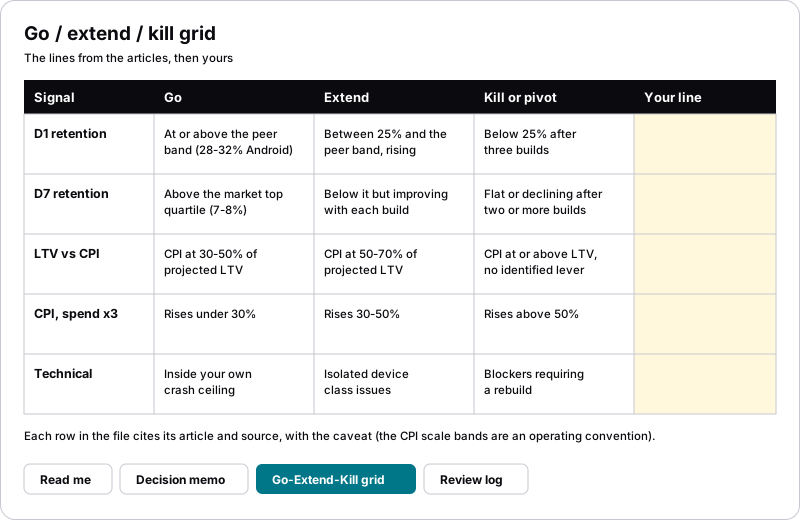
Preview of the scorecard's go / extend / kill grid: D1, D7, LTV against CPI, CPI scale test and technical rows, with an empty column for your own line

Decide go, extend or kill before the data arrives

The Soft Launch Decision Scorecard: a one-page decision memo and a criteria grid to fill in before launch. Free spreadsheet.

01

Read me

What the file is, how to use it in four steps, the colour code, the caveats to read first, and links to the articles behind every line.

02

Decision memo

Twelve fields to fill in and sign before the soft launch, from the one question the phase must answer to the kill consequence, plus the four-condition extension check.

03

Go-Extend-Kill grid

Five preconditions and seven decision criteria. Each row gives the article's go, extend and kill lines, the stop-and-fix signal, the caveat and the source, then columns for your own lines and actual value.

04

Review log

One row per decision review: build hypothesis, installs per cell, D1, D7, D30, projected LTV, CPI, an LTV / CPI ratio that fills itself, CPI change at triple spend, crash rate, reading and decision.

An Excerpt from the Scorecard

Grid row 6 · D1 retention

Go: At or above the casual and puzzle peer band by cycle 4 (28-32% on Android).

Extend, one more cycle: Between 25% and the peer band, rising build over build.

Kill or pivot: Below 25% after three build iterations.

Caveat: 25% is a floor, not a target. Median D1 across 11,600 live games is around 22%; top quartile 25-27% on Android, 31-33% on iOS. The 28-32% peer band is AppsFlyer Q3 2022 genre data, Android, casual and puzzle only, and about four years old.

Source the article cites: GameAnalytics, 2026 Mobile & PC Gaming Benchmarks; AppsFlyer, App Retention Benchmarks (Q3 2022 genre data).

From the Go-Extend-Kill grid sheet, quoting the Mobile Game Soft Launch 2026 guide

Who It's For

  • Founders, producers and heads of product preparing or running a mobile game soft launch.
  • Publisher portfolio managers who want a decision owner, a review date and a budget cap on every title in soft launch.
  • Teams who want the lines agreed and signed before the first cohort, not argued in the review.

Choose the Right Resource for the Problem

Best Fit

Use This Scorecard to Decide Go, Extend or Kill

This spreadsheet fits when the question is whether a game in soft launch should scale, get one more cycle or stop.

  • You are about to buy the first soft launch installs and have no written kill line.
  • Your reviews keep ending in another extension.
  • You need one decision owner, one date and one budget cap per phase.
Also Useful

Use the F2P Monetization Audit Once Retention Holds

Monetisation is tested only after the retention curve holds. When that is the open question, the F2P Monetization Audit reviews pricing, ads, retention and LiveOps in twenty questions.

  • Your retention clears your lines and revenue is the next question.
  • You need to review pricing architecture and ad strategy.
  • You want a benchmark-based self-audit with a scoring guide.
Explore the F2P Monetization Audit
Gameloft
SFR
Blacknut
Impulse Media Hub
Bouygues Telecom
Millimages
Daviking Code
CG

Cyril Guilleminot

Gaming Advisor | 20+ Years Experience

Former Gameloft executive with experience across mobile gaming, cloud gaming platforms and operator ecosystems, at Gameloft, SFR, Blacknut and Impulse Media Hub. I help studios write their decision criteria before the soft launch data arrives, and make the call when it does.

About Cyril Guilleminot

FAQ

What is in the Soft Launch Decision Scorecard?

Four sheets: a read-me with instructions and sources, a one-page decision memo with a four-condition extension check, a go / extend / kill grid of five preconditions and seven decision criteria, and a review log with one row per decision review.

Which format is the file?

An Excel workbook (.xlsx) with no macros. It opens in Microsoft Excel, Google Sheets and Apple Numbers. The yellow cells are the ones your team fills in.

Where do the criteria and thresholds come from?

From three published Game Growth Advisor articles: the complete soft launch guide, the soft launch kill criteria guide and the market selection guide. Each row names its article, the source that article cites and the caveat it gives. Where the articles give no number, the cell is left empty for your team.

Do the thresholds apply to every game?

No. The retention lines are Android figures, the casual and puzzle peer band comes from AppsFlyer Q3 2022 data, and the CPI scale bands are an operating convention with no published dataset behind them. The grid has columns for your own lines, adapted to your genre and economics.

Is the scorecard free?

Yes. The spreadsheet is free: enter your email address and it is sent to your inbox.

What happens to my email address?

We use it to deliver the spreadsheet and to send a short series of related commercial follow-up emails. Choose “Spreadsheet only — no follow-up emails” to get the spreadsheet alone; the newsletter is a separate, optional checkbox.