Free Spreadsheet

The Game Economy Template

Model a currency's sources and sinks and one player's balance over 60 days.

Get it free

We use your email to deliver the spreadsheet and send a short series of related commercial follow-up emails. Choose “Spreadsheet only — no follow-up emails” to opt out of those emails. Newsletter signup is separate and optional.

Check your inbox! The Game Economy Template is on its way.

Read our Privacy Policy

  • One row per source and per sink: amount, frequency, share of players and the days it is active
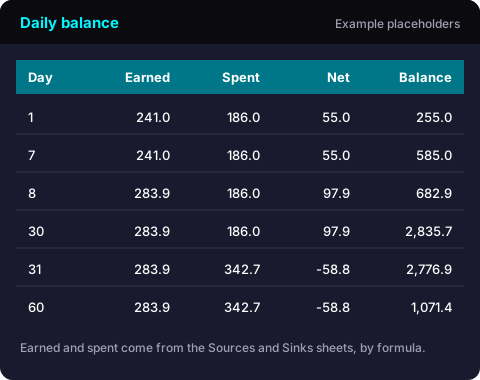
  • A 60-day daily balance computed by formula: earned, spent, net and cumulative balance
  • 16 checks drawn from our game economy guide, each citing the section it comes from
  • Every sink priced in days of average earnings, so costs read as play time, as the guide recommends
  • Example placeholders only: no benchmark to mistake for your game's numbers
Daily balance sheet of the Game Economy Template: six days of earned, spent, net and cumulative balance computed from the example placeholders

What's Inside, Sheet by Sheet

Balance your currency sources and sinks

The Game Economy Template: a sources-and-sinks spreadsheet to model a virtual currency before you tune it live. Free spreadsheet.

+

Sources

Each way a player earns the currency (mission rewards, daily logins, rewarded video, events): amount per occurrence, how many times every N days, the share of the segment that uses it, and the first and last active day.

-

Sinks

Each way the currency leaves circulation (upgrades, crafting, consumables, prestige items) with the same columns, plus the cost of each purchase in days of average earnings.

#

Daily Balance

Days 1 to 60 for one player segment: what the player earns, spends and nets each day, and the cumulative balance from the starting balance you set.

?

Checks

Inflow against outflow for the first week, days 8 to 30 and month two, spending in month two, days with a negative balance, and the audit questions to answer by hand.

An Excerpt from the Checks Sheet

Check 6 · Inflow ÷ outflow, month two (days 31-60)

Value: currency earned divided by currency spent over days 31 to 60, from the Daily balance sheet.

Reading: “Inflow exceeds outflow: inflation risk” when the ratio is above 1, “Outflow covers inflow in this window” otherwise.

From the article: A Practical Framework for Auditing Your Game Economy, step 4: ask what a committed player is spending on in month two.

Target: left empty, because the article sets no numeric ratio.

From the Checks sheet of the spreadsheet

Who It's For

  • Game designers, economy designers and product managers working on a free-to-play game with at least one virtual currency.
  • Teams preparing a soft launch or a monetization overhaul, the moments the guide recommends for an economy audit.
  • Data to gather first: every mechanic that adds or removes the currency, what each one gives or costs, and how often each segment uses it.

Choose the Right Resource for the Problem

Best Fit

Use This Template for the Currency Flow

This spreadsheet fits when the question is the economy underneath your monetization: how fast a currency arrives, where it goes, and whether the balance holds past the first week.

  • You want to see a currency's flow before you change it live.
  • You suspect inflation: players hold more currency than they can spend.
  • You need the month-two sinks on the table, not just the first week.
Also Useful

Use the F2P Monetization Audit for Pricing, Ads and Retention

If the bigger question is revenue per user, IAP conversion, ad monetization or LiveOps, the F2P Monetization Audit is the better entry point.

  • You need to benchmark ARPDAU, payer conversion and retention.
  • You want a structured self-audit of pricing and ad placements.
  • You need a short list of monetization priorities.
Explore the F2P Monetization Audit
Gameloft
SFR
Blacknut
Impulse Media Hub
Bouygues Telecom
Millimages
Daviking Code
CG

Cyril Guilleminot

Gaming Advisor | 20+ Years Experience

Former Gameloft executive with experience across mobile gaming, cloud gaming platforms, operator ecosystems, and strategic partnerships. I help teams make monetization calls when those choices sit inside bigger growth, distribution, and business development decisions.

About Cyril Guilleminot

FAQ

What is in the Game Economy Template?

Five sheets: Read me, Sources, Sinks, Daily balance and Checks. The Daily balance sheet projects what one player of a segment earns, spends, nets and holds each day for 60 days, by formula from the Sources and Sinks sheets.

Which apps can open it?

It is an .xlsx file with plain formulas (SUM, SUMIFS, AVERAGE, COUNTIF, IF) and no macros, array formulas or named ranges, built to open in Excel, Google Sheets and Numbers.

Are the example numbers benchmarks?

No. The values in the input cells are example placeholders so the formulas have something to compute: replace them with your own game’s values. The Target column of the Checks sheet stays empty because the source article sets no numeric threshold.

Where do the checks come from?

From the Game Growth Advisor guide to game economy design: its five-step economy audit and the warning signs it describes. Each of the 16 checks names the section of the article it comes from.

Can it model several currencies or player segments?

One workbook models one currency for one player segment. The article recommends modelling a new player, a mid-core player and a spender, so save one copy per segment and per currency.

What happens to my email address?

We use it to deliver the spreadsheet and to send a short series of related commercial follow-up emails. Choose “Spreadsheet only — no follow-up emails” to get the spreadsheet alone; the newsletter is a separate, optional checkbox.